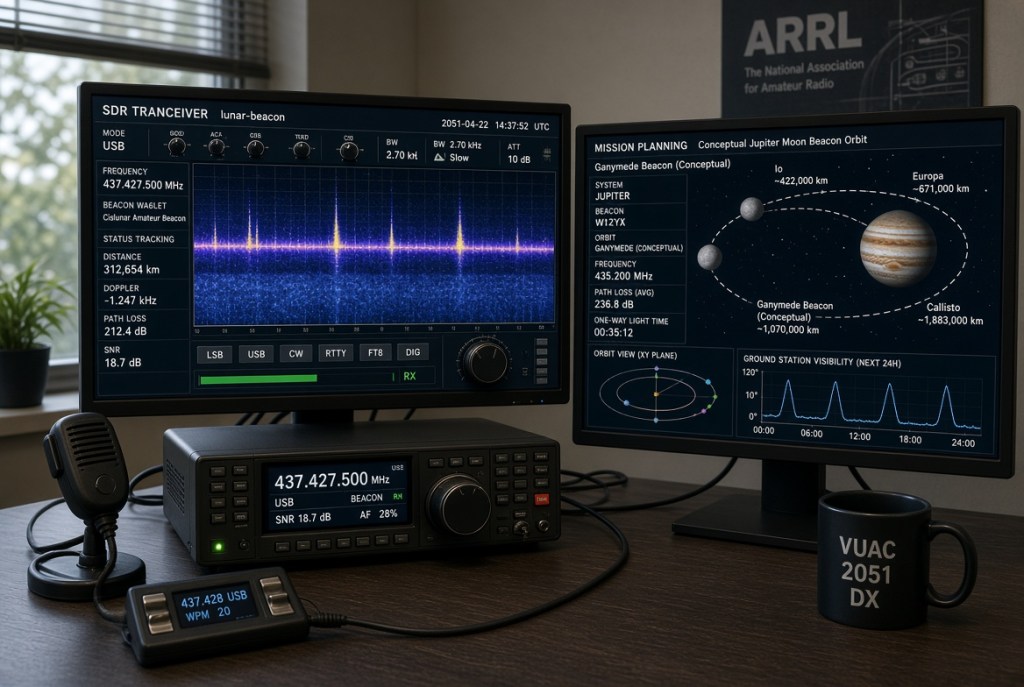
I was thinking about my club’s 50th anniversary coming up next month, and all the changes that have been made in those 50 years. This thought prompted me to spend a little quality time asking AI what it predicted for the next 100 years of Ham radio. I like where it went with this one. The prompt I gave it was pretty simple.
Write me a paragraph each for the state of the art ham radio from 100 years ago, 75, 50 and 25, and then do some prediction scenarios for 25 years, 50 years, 75 years, and 100 years from now. Include a graphic for each timeframe. use real images for the past and generate images for the future. Make the predictions as real-world as possible with your best guess.
I half expected Grok to be pessimistic about the future of Ham Radio, but I actually like the future it conjured up for us. I am imagining hyper accurate microsecond scale propagation predictions enabling radios to “dodge” atmospheric and man-made noise in real time. Quantum computer based SDR’s pulling impossibly weak signals out of the noise. Adaptive band utilization coordinating QSOs in real time, establishing contacts without interference instantly every time. Interplanetary experimentation is the new frontier while the traditional HF/VHF/UHF are still the terrestrial “Bread and Butter”
~1926 (100 years ago):
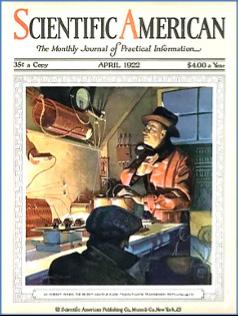
By the mid-1920s the spark-gap era was ending. Spark had been restricted and was soon banned on the new shortwave bands as vacuum-tube continuous-wave (CW) transmitters took over. Hams built or bought regenerative receivers and early master-oscillator power-amplifier (MOPA) transmitters using tubes such as the UX-210. Crystal control was just appearing. DX contacts with Australia, Europe, and South America were routine with modest power. The ARRL’s first Radio Amateur’s Handbook (1926) captured the homebrew spirit, and international callsign prefixes were about to be assigned. Phone (AM) was experimental; the dominant mode was hand-keyed CW on 160, 80, 40, and 20 meters.
~1951 (75 years ago):
Post-World War II surplus gear flooded the market while commercial SSB equipment began to appear. Oswald Villard’s 1948 SSB demonstrations and early homebrew designs (such as Don Norgaard’s “SSB Jr.”) showed the efficiency advantage over AM. RTTY experiments using surplus teleprinters started, though CW and AM still dominated. VHF activity grew, and the first solid-state experiments were underway. Stations mixed homebrew, military surplus, and early commercial transceivers; crystal control and improved superhet receivers were standard. The hobby was in a golden age of technical experimentation and rapid DX expansion.
~1976 (50 years ago):
Solid-state and hybrid transceivers (Kenwood TS-820, Yaesu, Drake, etc.) were widespread. SSB had largely replaced AM on HF. VHF/UHF FM repeaters blanketed populated areas. AMSAT’s OSCAR 6 and 7 satellites provided reliable 2 m–10 m and 70 cm–2 m links; many hams used them with modest equipment. Microprocessors were entering the shack—early computer-controlled systems and RTTY terminals appeared. Contests, DX, and emergency communications thrived. Homebrew was still common, but commercial gear and the first digital modes (beyond RTTY) were rising.
~2001 (25 years ago):
Personal computers and sound-card interfaces made digital modes practical. PSK31 (introduced 1998 by G3PLX) exploded in popularity for keyboard-to-keyboard chatting. Early software-defined radios and DSP filtering were appearing in commercial rigs and homebrew. The internet enabled logging, spotting, and remote operation. Portable and QRP activity grew. FT8 was still years away, but the foundation of computer-assisted weak-signal work and spectrum visualization was firmly in place. Stations typically combined a solid-state transceiver, computer, and modest antenna.
Now for the Future!
~2051 (25 years from now):
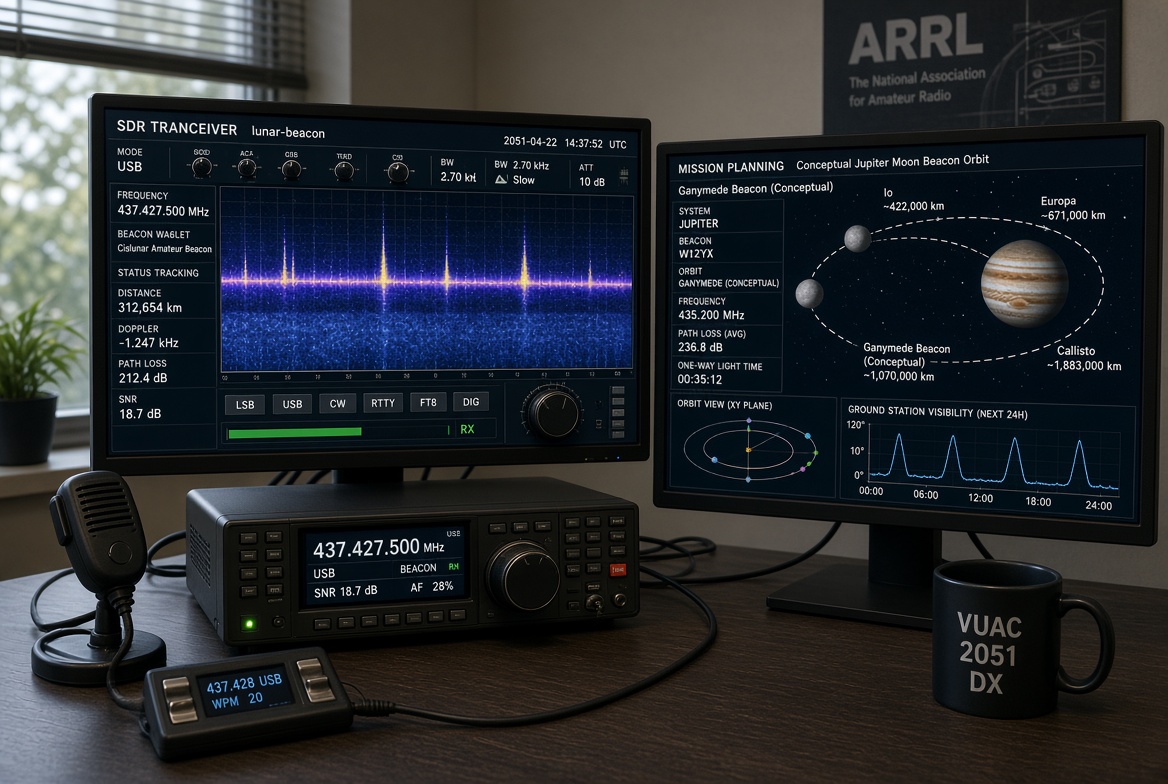
SDR technology is universal, with AI-driven noise reduction, signal classification, and real-time propagation prediction standard. Machine-learning digital voice modes dominate routine HF voice, while weak-signal digital protocols remain primary for DX. Cognitive radios manage spectrum sharing. Portable mesh networks expand for local and emergency work. HF, VHF, and UHF stay fully active. Early cislunar amateur beacons begin transmitting continuous low-power signals. Planning and early technology demonstrations for outer-planet beacons are underway, but no operational deep-space amateur beacons yet.
~2076 (50 years from now):
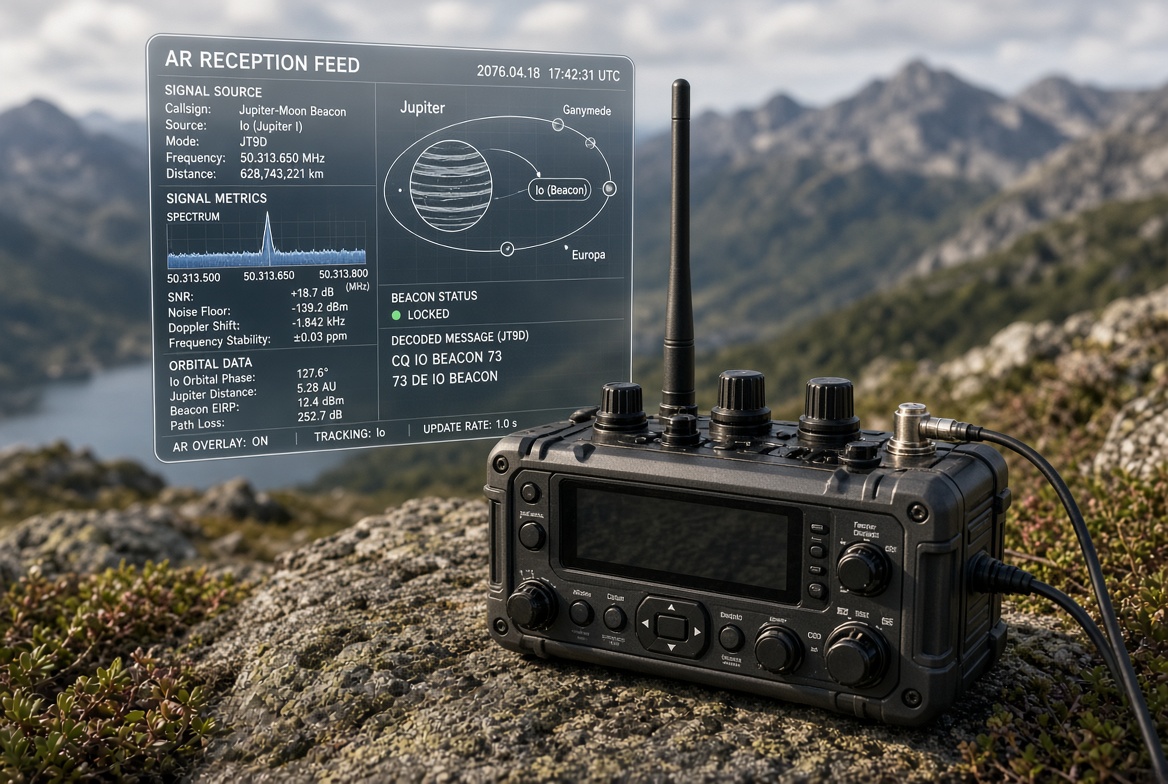
Radios are AI-native software platforms. Operators use voice, gesture, or light neural interfaces; stations are often portable modules with adaptive antenna arrays. Weak-signal digital modes operate well below earlier noise floors. Amateur lunar surface and cislunar beacons are established and regularly monitored. Early Mars orbital and surface beacons transmit simple telemetry. The first amateur beacons in orbit around Jupiter’s moons (such as Io or Europa) are launched on rideshare missions; they transmit low-power CW or digital identification and basic telemetry on selected VHF/UHF or microwave frequencies, receivable on Earth during favorable alignments with large antenna arrays or sensitive SDRs. HF, VHF, and UHF remain essential for terrestrial and nearer-space work.
~2101 (75 years from now):
Amateur activity integrates with global sensor and interplanetary networks. Permanent or semi-permanent amateur stations and beacon networks exist on the Moon; Earth operators regularly monitor lunar, cislunar, and Mars beacons. Multiple amateur beacons operate in orbits around Jupiter’s major moons, providing continuous reference signals and telemetry that support scientific collaboration and rare two-way experiments. Early deep-space amateur beacons (beyond Jupiter, in the outer solar system) are deployed on long-duration probes, transmitting low-rate data and identification. AI handles routine spotting. HF, VHF, and UHF remain in regular use for terrestrial resilience and nearer beacons; longer-range links increasingly use hybrid radio/optical methods.
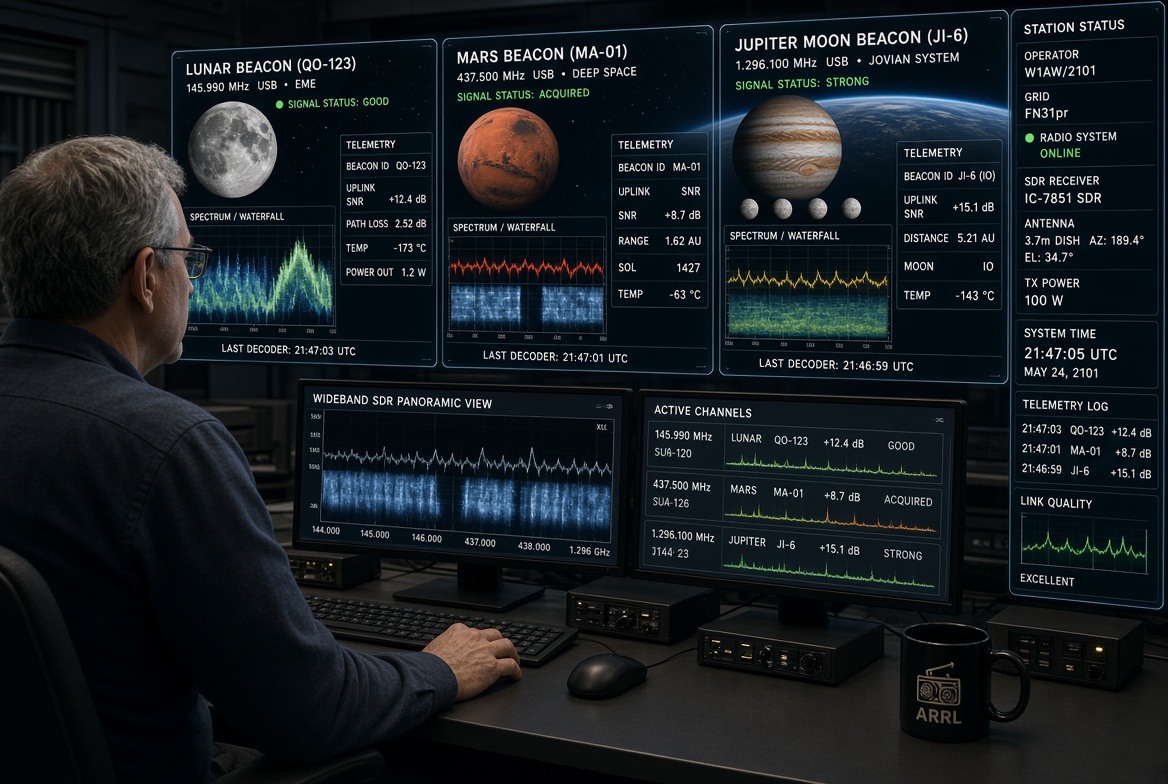
~2126 (100 years from now):
Amateur radio continues as a regulated experimental and public-service service. A mature network of cislunar, lunar, Mars, Jupiter-moon-orbit, and deep-space amateur beacon stations provides continuous reference signals, telemetry, and low-rate data. Jupiter-moon beacons (Io, Europa, Ganymede, Callisto) are routinely monitored; deep-space beacons farther out serve as calibration sources and emergency backup links. Interplanetary contacts occur regularly using a mix of radio (where practical on HF/VHF/UHF or higher bands) and optical methods. Extremely efficient digital modes and adaptive systems support reliable work. HF, VHF, and UHF are still allocated and actively used for terrestrial resilience, ionospheric work, and monitoring nearer beacons. The core appeal of building, testing, and making a contact remains.
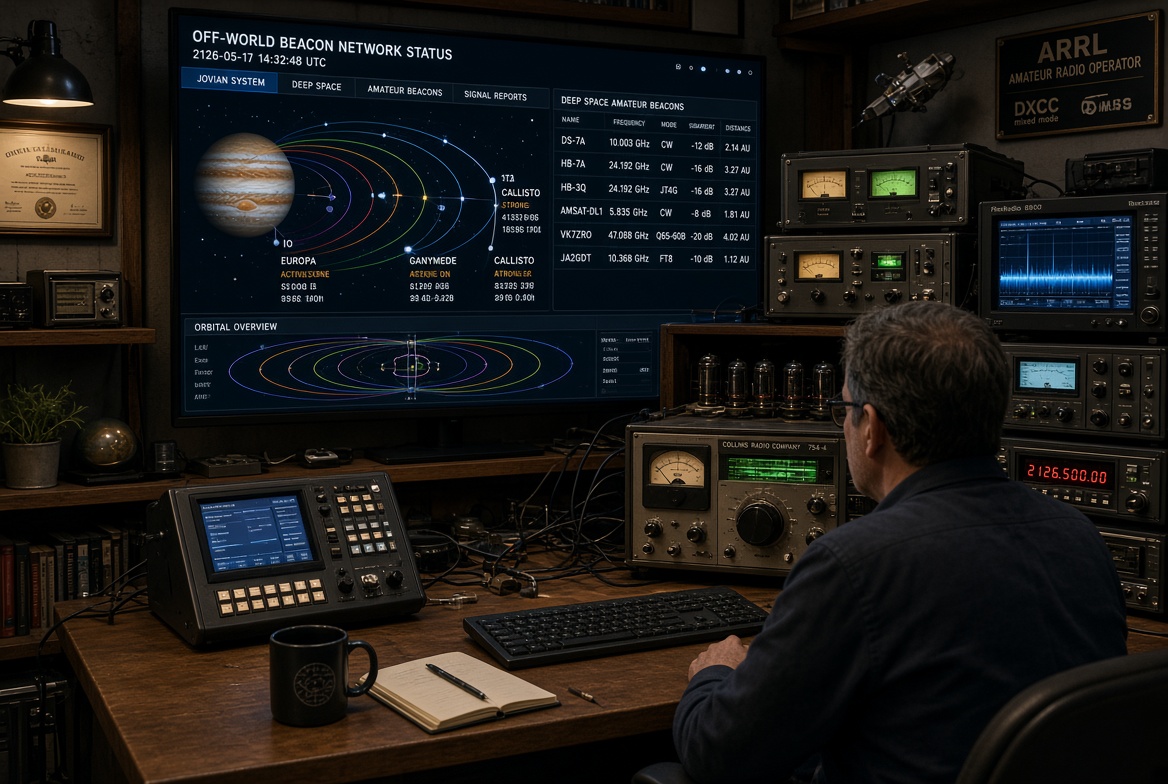
These outer-system beacons extend the amateur tradition of shared reference signals into the solar system while leaving HF, VHF, and UHF in active terrestrial and near-space service.


Leave a Reply