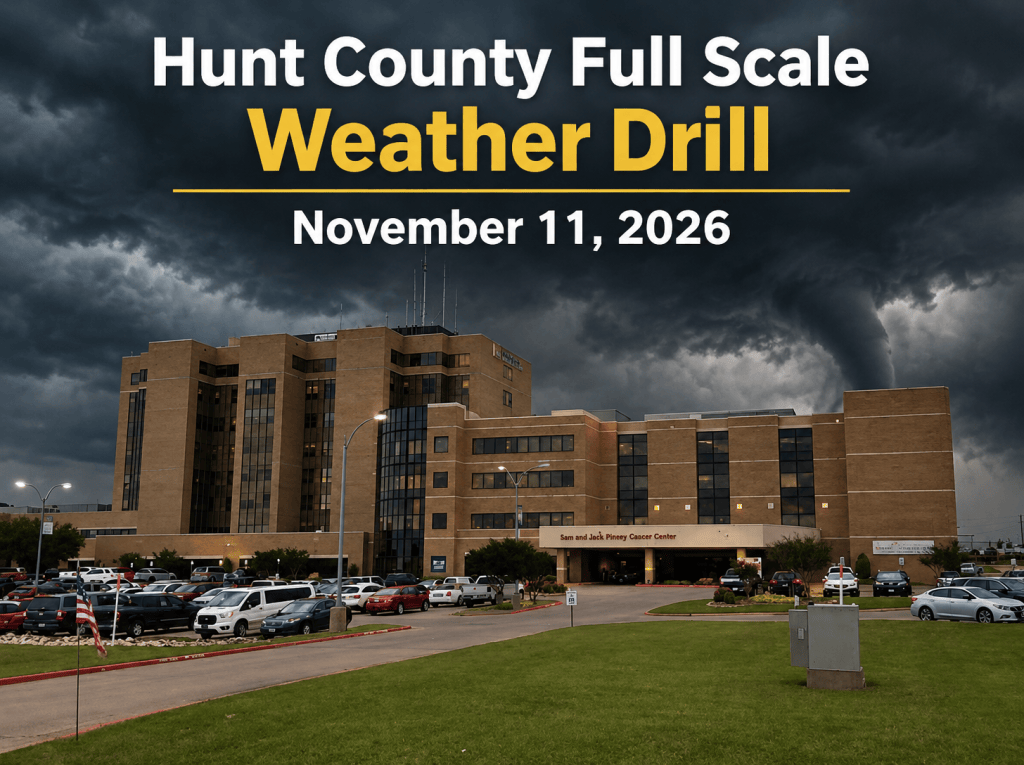
The words “THIS IS ONLY A DRILL!” were not completely comforting that night.
The air over Hunt County had grown thick and restless by late Wednesday afternoon. Clouds the color of old bruises stacked along the western horizon, and the wind carried that metallic, ozone smell that comes just before the atmosphere decides to rearrange the landscape.
Cliff N5CLF was manning the SKYWARN net as Net Control and he had everybody checked in and assigned. Larry KE5HMR, one of our normal “Chasers” was not available, as he had been in DFW during the day. He was driving in, but unable to help spot quite yet, but he was among the first hams to arrive at the hospital.
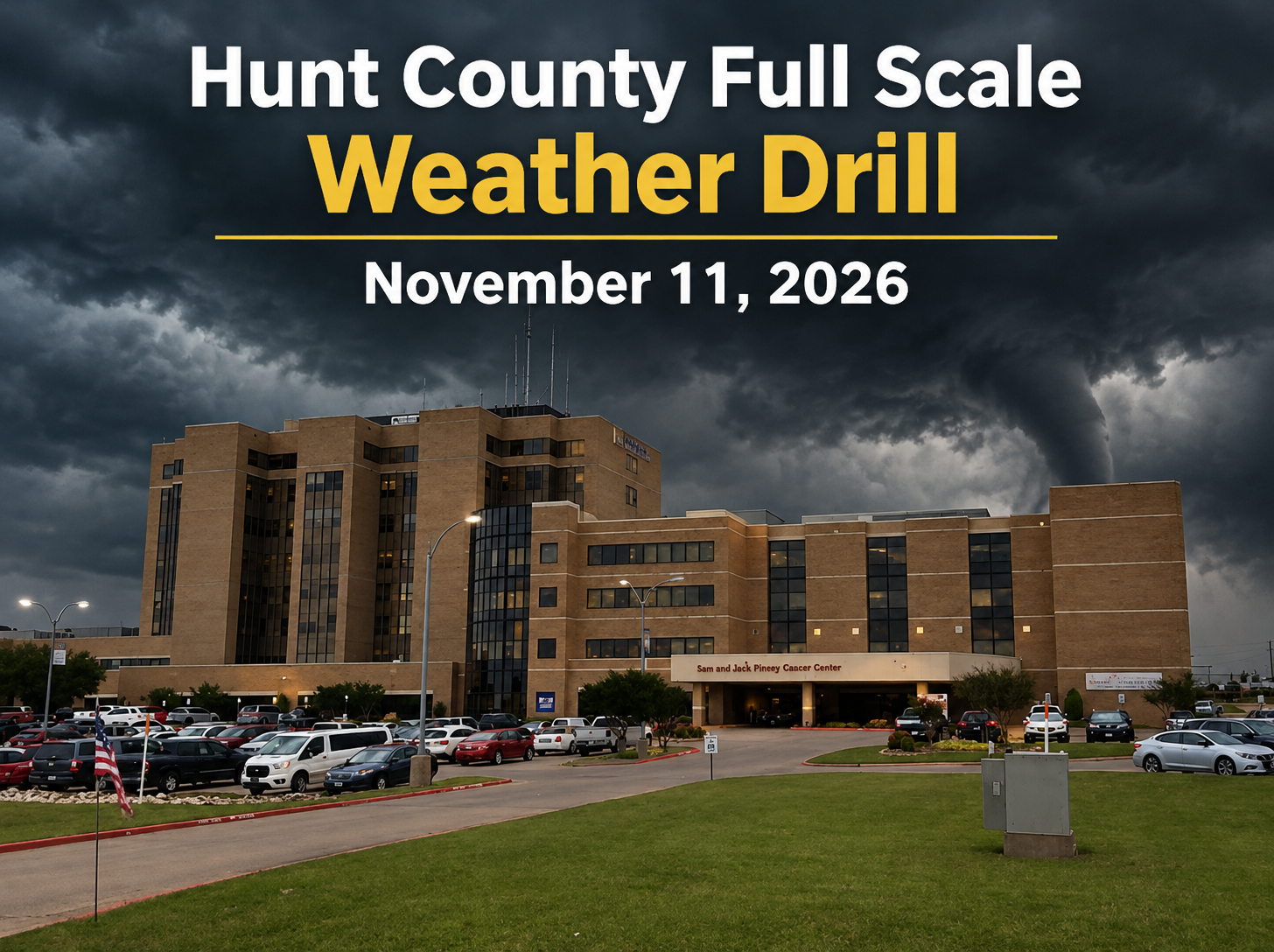
At Hunt Regional Medical Center the evening shift moved through the corridors under the ordinary hum of fluorescent lights and distant monitors, while outside a construction crane stood silhouetted against the darkening sky like a giant’s idle arm. No one inside yet knew that the arm would not stay idle.
At 8:15 p.m. the drill’s scenario became real enough to freeze the blood. A tornado touched down and struck the hospital. The crane on the roof toppled, crashing through the structure and annihilating the IT room in a single grinding collapse of steel and concrete. Cell antennas, the hospital’s own repeater, and every other antenna array on the building were torn away or crushed. Inside the hospital it was Bedlam. The internal phone system and intercom system went down the instant the IT room was destroyed. In the space of a few violent seconds the facility that the county depends on for life-saving care was cut off from the outside world—phones silent, internet dead, radio links gone. The only sound left was the howling wind, piles of brick and steel setting, water pouring into the hallways. and the rising noise of alarms that no longer had anywhere to send their warnings.
Following behind the chaos, Mike W6MCP had been tracking the storm cell from the meager safety of his truck. The instant the funnel cloud became visible he did not hesitate. Over the air he put the report into the National Weather Service network, giving the first confirmed ground truth of what was already unfolding. That single transmission turned a developing weather event into actionable information. Within minutes the Sabine Valley Amateur Radio Association SKYWARN net shifted. Operators abandoned the now-useless hospital systems and moved to the output frequency of the K5GVL repeater on 146.780 MHz. (This was simulated on 146.550 by Jim KD5PAD’s awesome Cross-band repeater)
The frequency filled with clear, controlled voices. Members who had been monitoring from home, from vehicles, and from other fixed stations began rolling toward HRMC without waiting for a formal call-out. They arrived with handhelds, mobile rigs, extra batteries, and the quiet competence that comes from years of training for exactly this kind of night.
Inside the darkened hospital the amateur radio operators set up at every entrance, passing traffic between emergency management, incident command, and arriving resources. Messages that would have vanished into dead circuits moved instead by voice and by packet. Status reports on patients, requests for additional personnel, and damage assessments all found a path out of the building because licensed operators were standing in the wind with antennas that the tornado had not yet claimed.
A block away, another part of the response took shape at Highland Terrace Church. There the American Red Cross established a re-unification center for families seeking word of loved ones who had been at the hospital. Jack KB5TMY was already on site, linking the church to the wider emergency network. He kept the flow of information moving between the center, the hospital radio operators, and the county emergency operations center so that anxious relatives received accurate updates instead of rumor. In the soft light of the church fellowship hall, families waited with the particular stillness of people who do not yet know whether their names will be called. Jack’s radio traffic was one of the few steady threads holding that room together.
By 10 p.m. the exercise window closed, but the lessons did not. The drill had stripped away every ordinary means of communication and left only the systems that amateur radio operators maintain precisely because ordinary systems fail. The K5GVL machine had carried the load. The operators who left their homes on a weeknight had filled the gaps. Mike’s early warning had bought precious minutes. Jack’s work at the church had kept the human side of the disaster from becoming pure chaos. None of it required perfect conditions or unlimited infrastructure—only trained people, functional equipment, and the willingness to move when the call comes.
This was the drill scenario that played out last Wednesday night at the hospital. Luckily it was JUST a drill. In reality we all learned a few important lessons. Jim’s Crossband repeater was AWESOME, but we had to wait a couple of seconds between transmissions to allow the link to drop cleanly. Most of us had a “I should’ve packed an X.” moment. I need to pack a dedicated “Go Bag” before storm season.
The SVARA participants were:
Cliff N5CLF – Net Control
Don KB7ZJP
Devlin N5HB
Jim KD5PAD
Larry KE5HMR
Mike W6MCP
Jack KB5TMY – Red Cross Reunification center
Joe KE5ZBL
Kerry WD5ABC
Ken AC0TG
I am not completely sure I captured everyone involved, so please let me know if I missed a name.
In the quiet that followed the scenario’s end, the operators packed their gear under the same sky that had looked so threatening hours earlier. The clouds were still there, but the hospital lights were back on, the radios were still charged, and the network that had carried the night’s traffic remained ready for the next time the weather decides to test the county. What began as a sudden, terrifying loss of every normal link ended as a clear demonstration that Hunt County is not without a voice when the antennas fall and the phones go dark. The sky can still turn, but the operators who watch it will be listening.


Leave a Reply