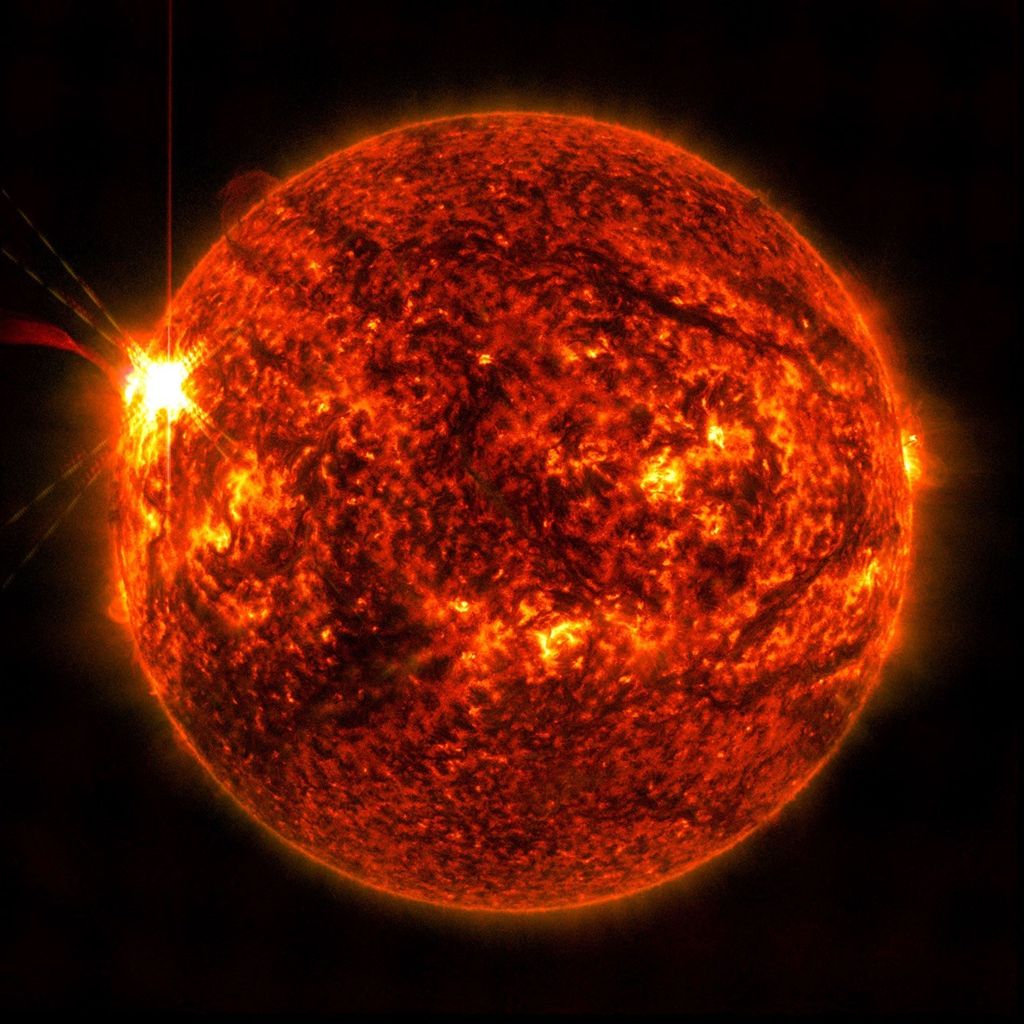
A few years back, Jess W5ACY and I were activating Parks on the Air from Tawakoni State park. The bottom dropped out of it and we ended up sitting in the truck with the IC705 on the dashboard and coax running out the window to the antenna while we operated during the rain storm.
We were making contacts and Jess was asking questions about how the rain would effect the signals and such. I was doing my best to answer her questions as we stacked up the contacts and activated the park.
Right in the middle of one of her QSOs, the station slowly faded out to be replaced with a steady static hiss. The entire band went dead at the exact same time. the waterfall on the 705 went from bustling with activity to completely dead in just a few seconds.
Jess asked “What the hell just happened?!” and I answered “Solar Flare I think”. The rain had let up a little and we had our 10 contacts, so I took the opportunity to pack up and head for home.
On the drive home, she asked a few more questions like “How long will the blackout last?” and “What happens after the blackout ends?”. I realize there is not a lot of info out there about the actual “On the Air” effects on ham radio operation from a solar flare, so…
Here’s a practical, real-time guide to what you should expect—and when—if that flare is significant (M- or X-class) and potentially accompanied by the usual follow-on events.
Flare! (8 minutes later) Radio Blackout / R-scale
A solar flare is a sudden, intense eruption of electromagnetic radiation from the Sun’s atmosphere, typically occurring near active regions with strong, tangled magnetic fields such as sunspots. These events arise when magnetic field lines become stressed and reconnect, rapidly converting stored magnetic energy into kinetic energy, heat, and radiation across the spectrum—from radio waves to X-rays and gamma rays. Flares are classified by their X-ray intensity (A, B, C, M, or X classes), with the largest lasting from minutes to several hours and releasing energy equivalent to billions of megatons of TNT.
While the radiation from a solar flare reaches Earth in about eight minutes and can disrupt radio communications, GPS signals, and satellite operations—especially on the sunlit side of the planet—the accompanying coronal mass ejections that sometimes follow travel more slowly and may trigger geomagnetic storms days later. These storms can induce currents in power grids, enhance auroral displays at high latitudes, and pose radiation hazards to astronauts and high-altitude aircraft. Despite their potential impacts, solar flares are a natural part of the Sun’s 11-year activity cycle and are continuously monitored by space-based observatories.
The electromagnetic radiation (X-rays and extreme UV) left the Sun at the speed of light. It reaches Earth about 8 minutes after the flare peak.
What you experience:
- On the sunlit side of Earth, the D-layer of the ionosphere suddenly becomes heavily ionized.
- HF signals, especially on 80 m through 20 m (and sometimes higher bands in big events), get absorbed. Your receiver goes quiet or signals drop dramatically on daytime paths.
- Night-side paths are mostly unaffected.
- The blackout usually lasts from a few minutes up to an hour or two, depending on how strong and long-lived the flare is. Stronger flares (R3 and above) can keep daytime HF dead longer.
What to do:
Check the current GOES X-ray flux. If it’s still elevated, daytime HF is compromised. Switch to night paths, higher bands if they’re open, or just wait it out. VLF signals often get stronger during these events if you monitor those.
Solar Energetic Particles / Radiation Storm (20 minutes to a few hours later) S-scale
A solar energetic particle (SEP) event, also known as a radiation storm, occurs when the Sun accelerates protons, electrons, and heavier ions to extremely high energies – often exceeding tens or hundreds of MeV – during intense solar flares or the shock waves driven by fast coronal mass ejections. These particles stream outward along magnetic field lines in the solar wind and can reach Earth within minutes to hours, depending on their energy and the magnetic connectivity between the eruption site and our planet. The strongest events are classified by the National Oceanic and Atmospheric Administration on an S1–S5 scale based on the flux of >10 MeV protons measured near Earth.
Once they arrive, SEPs penetrate spacecraft, aircraft, and the upper atmosphere, delivering ionizing radiation that can damage satellite electronics, elevate radiation doses for astronauts and high-altitude aircrew, and disrupt high-frequency radio communications over the polar regions. Although Earth’s magnetic field and atmosphere shield most of the surface, the particles can still produce secondary neutrons that reach the ground during the most extreme events. Continuous monitoring by spacecraft such as GOES and SOHO allows forecasters to issue warnings so operators can power down sensitive systems or adjust flight paths when a major radiation storm is underway.
If the flare (or its associated shock front) accelerated high-energy protons, the fastest ones start arriving in as little as 15–30 minutes. The bulk of the particle flux can continue for hours.
What you experience:
- Polar Cap Absorption (PCA). High-latitude and polar paths (including many transpolar DX routes) suffer strong HF absorption.
- Mid-latitude paths are usually much less affected.
- In stronger events the polar blackout can last hours to a couple of days.
What to do:
If you work polar paths or high-latitude stations, expect them to disappear or become very weak. Stick to lower- and mid-latitude routes. Keep an eye on the >10 MeV proton flux; rising numbers confirm an S-scale event is underway.
Coronal Mass Ejection arrival (0.5-4 days later) Geomagnetic Storm / G-scale
A coronal mass ejection (CME) is a vast expulsion of plasma and embedded magnetic fields from the Sun’s corona into interplanetary space, often involving billions of tons of material accelerated to speeds ranging from a few hundred to more than 3,000 km/s. These events commonly originate in active regions where magnetic fields become highly stressed, and they are frequently—but not always—linked to solar flares or filament eruptions; the sudden release of magnetic energy drives the plasma outward as a bubble or loop-like structure that expands as it travels through the solar wind.
When a CME is directed toward Earth, it can arrive in one to five days and compress the magnetosphere, potentially triggering intense geomagnetic storms. The resulting disturbances can induce currents in power grids, disrupt satellite operations and radio communications, and produce spectacular auroras at unusually low latitudes. Space-weather agencies track CMEs with coronagraphs and in-situ spacecraft so that operators can prepare critical infrastructure and astronauts for the possible impacts of a strong Earth-directed event.
Many strong flares launch a CME. The plasma cloud travels much slower. Fast ones can hit Earth in 15–18 hours; most take 1–3 days.
What you experience once it arrives:
- A geomagnetic storm begins when the CME’s magnetic field interacts with Earth’s.
- The ionosphere becomes disturbed: Maximum Usable Frequency (MUF) often drops, signals become unstable, multipath and fading increase, and auroral absorption hits high latitudes hard.
- Polar paths usually degrade first and worst. Longer DX paths can suffer reduced reliability or complete blackouts on some bands.
- Strong storms can last many hours to a couple of days, with residual unsettled conditions for longer. You may also see enhanced aurora that can support unusual VHF/UHF propagation or create HF noise.
What to do:
Watch solar wind data from the L1 satellites (speed, density, and especially the Bz component—southward is the troublemaker). Once the storm hits, expect variable to poor HF conditions, especially on higher bands and high-latitude paths. Lower bands may still work for closer contacts. This is often the longest-lasting and most widespread disruption of the whole sequence.
Putting it all together in practice
A single active region can give you the full sequence: immediate daytime HF blackout from the flare, polar-path problems from the particles a short while later, and then a multi-day geomagnetic storm when the CME arrives. Not every flare produces the full package—many are “flare only”—but the bigger the event, the higher the chance of all three.
Useful real-time checks:
- GOES X-ray flux → flare/blackout status
- Proton flux → radiation storm / polar absorption
- Solar wind + Kp/Ap → geomagnetic storm progress
- D-Region Absorption Prediction maps → quick visual of current HF absorption
Stay flexible, have alternative bands or modes ready, and remember that after the storm settles the ionosphere often recovers with some excellent openings. That’s the practical reality when the Sun decides to put on a show.
As I have always told Jess, “The Sun ALWAYS wins!” when it comes to Amateur Radio. We do out best to have options and skills to adapt to it but the sun still decides.
How big can these events get?
I’m glad you asked!
The Carrington Event was the most intense geomagnetic storm in recorded history, peaking on 1–2 September 1859 during solar cycle 10. On the morning of 1 September, British astronomer Richard Carrington (and independently Richard Hodgson) observed a brilliant white-light solar flare erupting over a large group of sunspots; this was the first solar flare ever recorded by human observers. The flare was linked to a massive coronal mass ejection (CME) that raced toward Earth, covering the roughly 150 million km distance in only about 17.6 hours.
When the CME slammed into Earth’s magnetosphere, it triggered extreme geomagnetic disturbances, with estimated Dst indices ranging from roughly −800 to −1,750 nT. Spectacular auroras appeared worldwide—visible as far south as Cuba, Hawaii, Mexico, and even near the equator—and were bright enough in some places that people could read newspapers outdoors at midnight. Telegraph systems across Europe and North America failed dramatically: operators received electric shocks, equipment sparked and set paper ablaze, and in some cases lines continued transmitting messages after batteries were disconnected, powered solely by geomagnetically induced currents.
If a Carrington-level storm struck today, the consequences would be far more severe because modern society depends so heavily on electrical grids, satellites, and digital infrastructure. Geomagnetically induced currents could overload and permanently damage high-voltage transformers, potentially causing widespread blackouts affecting tens of millions of people for days, weeks, or even months to years in the worst-affected regions (especially mid- and high-latitude areas with vulnerable geology). Satellites would face radiation damage, surface charging, and increased atmospheric drag that could push low-Earth-orbit craft into premature decay or failure, disrupting GPS navigation, communications, weather forecasting, and timing systems used by aviation, shipping, finance, and agriculture.
Radio blackouts, internet outages (via undersea cables and data centers), and cascading failures in water treatment, transportation, and supply chains would compound the disruption. Economic estimates for a comparable event range from roughly $0.6–2.6 trillion in first-year U.S. damages alone (Lloyd’s of London assessments) to global losses of $2.4 trillion or more over several years, with recovery timelines stretching years in extreme scenarios. While forecasting and some grid-hardening measures exist, a true Carrington-class event remains a high-impact, low-probability risk that space-weather agencies continue to monitor closely.
The. Sun. ALWAYS. Wins.


Leave a Reply