SVARA Keeps 400-Plus Riders Connected
Saturday, September 19, dawned hot and clear over downtown Greenville, the kind of North Texas morning that promises long miles, dry pavement, and plenty of water stops. For the Sabine Valley Amateur Radio Association, it was also a working day. SVARA rolled its communications trailer onto Lee Street, parked it beside the Landmark building, and spent the rest of the morning doing what the club does best: putting amateur radio where it matters, beside a community event that needed reliable eyes and ears across Hunt County and beyond.
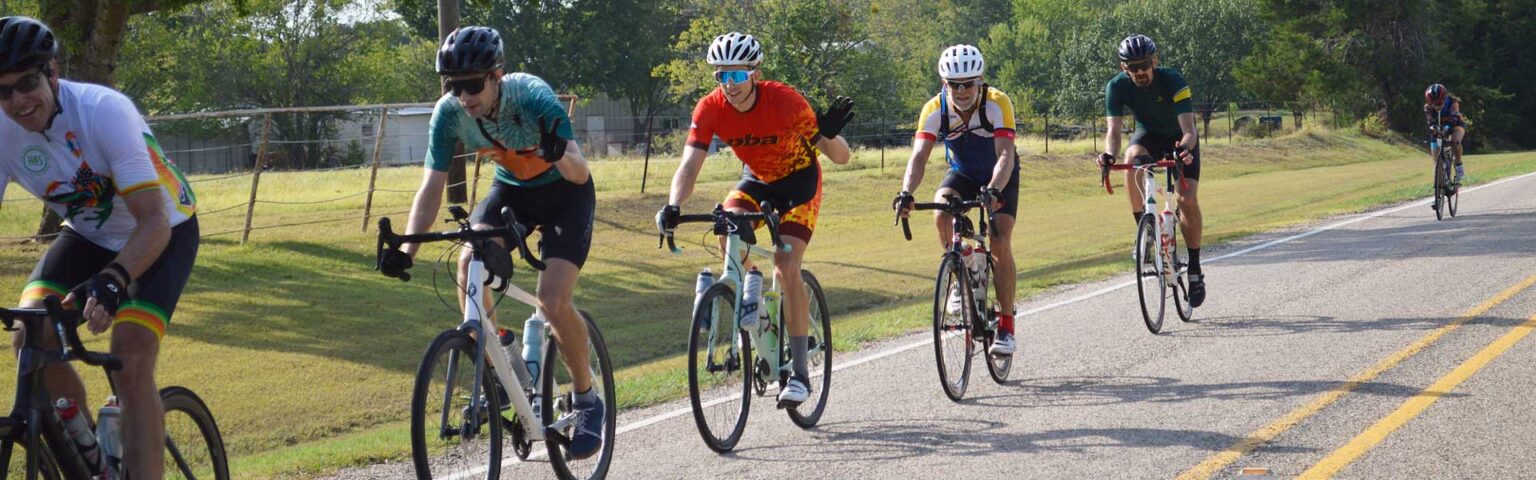
This year’s Cotton Patch Challenge marked the 30th anniversary of a ride that began in 1996 as a local cycling tour and has grown into one of the region’s signature charity events. Hosted by the Rotary Club of Greenville, the Challenge sends riders out of downtown on a menu of road rally distances from six miles to a full century, plus gravel grinder routes of 31, 42, and 57 miles that drop into the Sabine River bottom south of town. Longer road courses still claim the famous two-mile crossing of Lake Tawakoni. Check-in opened at 6 a.m., the official start came at 7:30, and more than 400 cyclists rolled out under a cloudless sky.
SVARA’s assignment was not to race. It was to listen, relay, and keep the organizers connected when cell phones got thin, SAG wagons needed a destination, and a rider needed help on a farm-to-market road far from the courthouse square.
Net Control on Lee Street
Net control for the day was Devlin Kirchman, N5HB, and Jim Davenport, KD5PAD. From the comms trailer they ran the net, tracked shadow traffic from operators out on course, and stayed in reach of Rotary volunteers, SAG drivers, and rest-stop crews. The trailer’s location next to the Landmark building on Lee Street put the station in the heart of the start-finish area without blocking riders or registration.
One practical decision paid off immediately. Instead of firing the trailer generator and living with the extra heat and noise, the team drew commercial power from the Landmark building. On a day that was already going to be hot, that choice kept the operating position cooler, quieter, and easier to staff through the long morning. Operators could hear the net without competing against a running engine. Batteries stayed topped off. The air inside the trailer stayed closer to livable than it would have been with a generator idling a few feet away.
That did not mean the radio side was plug-and-play. SVARA had new dual-band radios in the mix, and getting them programmed and talking cleanly on the intended repeater frequencies took more time than anyone wanted at the beginning of a public-service event. There was a stretch of fiddling, confirming offsets and tones, and double-checking that what was displayed on the radio matched what the net actually needed. It was the kind of small, familiar headache that shows up whenever new gear meets a live event. The team worked through it and got traffic moving.
One gap remained. Direct contact with the Rains County repeater never materialized. Operators could not hit that machine from the Lee Street site the way they had hoped. For a ride whose longer legs push south and east toward Emory and the Lake Tawakoni country, that missing path mattered. Net control adapted the way field operators always do: they used the machines and simplex paths that did work, relied on relays when a station was in a hole, and kept the net disciplined so that a weak path did not turn into a lost rider report. The lesson is already written down for next year. Pre-event radio checks from the actual trailer location, with the same dual-band radios and the same antenna setup, need to include a deliberate test of the Rains County pair—not just a paper frequency list.
A Fast Start, Then the Real Work
The gravel grinders went out first. Almost immediately they missed the initial left turn and started down the wrong path. That is the sort of thing that looks small on a course map and feels large when a pack of riders is already rolling. SVARA and course marshals got them steered back onto the correct line before the mistake became a long detour. It was an early reminder of why the club was there. A bicycle event of this size is a moving puzzle. The first turn after the start is often the one that gets missed, especially when gravel riders are eager, the pack is bunched, and signage has to compete with adrenaline.
After that, the day settled into the rhythm every public-service operator knows. Traffic came in bursts. Rest stops called in when they were ready. SAG needed a location. A rider was off the planned line. Someone wanted to know whether a particular group had passed a checkpoint. N5HB and KD5PAD kept the net moving without turning it into chatter. That is harder than it sounds when the weather is hot, the trailer is busy, and the event organizer is standing a few yards away with a question.
The heat was real. There was no rain and almost no cloud cover, which made for good riding visibility and a long, bright morning for anyone sitting in a vehicle or standing at a corner. Hydration and shade became part of the safety picture as much as radios. The good news, and it is the news that matters most at the end of a ride this size, is that there were no serious injuries. Four hundred-plus people on mixed road and gravel, across farm roads and a major lake crossing, and the event closed without a major medical emergency. That is not luck alone. It is course design, Rotary volunteers, SAG support, and a communications net that can put help on the right road instead of the next road over.
Dogs, an Armadillo, and a Four-Year-Old
Not every incident was a crisis. A few riders reported being chased by dogs near West Tawakoni. Anyone who has worked a rural Texas bike ride has heard that call before. Farm and lake-community roads are working landscape. Dogs do what dogs do. Operators passed the reports so SAG and later riders could be aware of the stretch. Nobody needed an ambulance. The net treated it as a safety note, not theater.
One rider had a more unusual mechanical. He ran over a dead armadillo and broke his bike chain. There is a sentence you will not find in most ARRL public-service manuals, and yet it is exactly the kind of thing that happens when a course leaves town and meets Texas pavement. The armadillo did not survive the previous night. The chain did not survive the armadillo. A SAG wagon and a spare link, or a ride back to town, turned a roadside curiosity into a story instead of a stranded cyclist in the sun.
Then there was the smallest rider of the day. A four-year-old boy completed the six-mile course with his parents. In a field that included century riders and gravel grinders chewing through sand and gravel, that short loop is easy to treat as an afterthought. It is not. The six-mile route exists so families can be part of the same morning as the people who will later cross Lake Tawakoni. Watching a child that young finish, flanked by parents, is a useful reminder of why Rotary keeps the short option on the board and why SVARA covers the whole event rather than only the long routes. Public service is not only the distant rest stop. It is also the first few miles of Lee Street, where a family is still finding its pace.
Why the Radios Still Matter
It is fair to ask, in 2026, why a bicycle fundraiser still wants amateur radio. Downtown Greenville has cell service. Many riders carry phones. Event apps exist. The answer showed up in the same places it always does: at the edge of coverage, in the first-turn mix-up, in the dog reports near West Tawakoni, and in the simple fact that a net control station can talk to several places at once without hoping every volunteer is looking at the same group text.
The Cotton Patch Challenge is not a closed-circuit race. Riders are on public roads. Distances fan out across Hunt County and brush Rains County. Gravel routes leave the pavement. The two-mile Tawakoni bridge is beautiful and also a long, exposed line with limited places to pull off. When something happens out there—a missed turn, a mechanical, a medical call—the organizer needs a single place that already has the picture. That place, on September 19, was the SVARA trailer on Lee Street.
The dual-band programming snag and the failure to reach the Rains County repeater directly are not embarrassments. They are after-action items. New radios will keep showing up. Repeaters will keep having dead spots from a given parking space. The professional habit is to write those things down while the event is still fresh, then test them on a quiet Saturday instead of discovering them again at 7:25 a.m. with gravel grinders already clipped in.
Using building power instead of the generator is the other kind of lesson: the one that worked. Quiet net control is better net control. On a hot day, every degree and every decibel counts. Future deployments next to a willing building should ask early about a clean outlet, a safe cord path, and whether the Landmark-style arrangement can be repeated.
A Word from the Organizer
Katy Ridge, who has been the public face and working contact for the Challenge, was plain about what the club’s presence meant.
“SVARA gave us a calm center on a very busy morning,” Ridge said. “With more than four hundred riders on road and gravel, we needed people who could listen, relay, and stay on the job when a turn got missed or a rider needed help out toward West Tawakoni. Devlin, Jim, and the operators around them did exactly that. They parked the trailer where we needed it, they worked through the radio setup without making it our problem, and they stayed professional from the first gravel wave to the last riders on the 100-mile course. Rotary is grateful. Please tell your members the Cotton Patch Challenge is better and safer because they showed up.”
That is the quote the club can hang onto. Event organizers do not always understand amateur radio. When they do, and when they say so in public, it is worth recording.
What SVARA Takes Home
The Cotton Patch Challenge is a fundraiser. Rotary directs proceeds to Hunt County nonprofits—family services, children’s programs, health and community groups that do not make the newspaper every week. SVARA’s part is not the check. It is the infrastructure that lets the ride happen without gambling on coverage. That is the same muscle the club uses for SKYWARN, fairground support, and emergency work with local agencies. A bike ride on a clear September Saturday is practice with consequences. People are actually out there.
N5HB and KD5PAD ran a clean net. The trailer sat in the right place. Commercial power was a smart call. The gravel start needed a correction and got one. Dogs, an armadillo, and a broken chain became handled traffic instead of mysteries. A four-year-old finished six miles with his parents. More than four hundred riders came home. Nobody went to the hospital with a serious injury.
There is still work on the radio plan: finish the dual-band templates before the next event, and solve the Rains County path from downtown so net control is not guessing when the long routes lean that direction. Those are good problems. They mean the club is using the gear hard enough to find the edges.
For members who were on course, in the trailer, or on standby, thank you. For members who were not, this is what the next invitation looks like. Public service is not abstract. It is Lee Street at dawn, a hot clear sky, a net that has to work, and a community event that is safer because K5GVL showed up.
The Cotton Patch Challenge will be back. So will SVARA. Next time the first left will still try to hide from the gravel wave, and there will still be dogs near the lake. The difference will be a radio plan that already knows how to talk to Rains County, radios that are programmed before the coffee is poured, and a trailer that once again does not need to wake the neighborhood with a generator. That is how a club gets better at the work it already does well.


Leave a Reply